
Boswellia
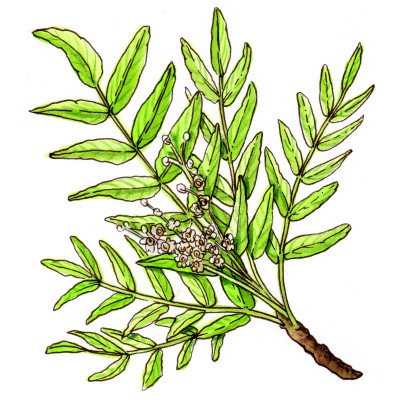
 Boswellia (Boswellia serrata), also known as Indian frankincense, belongs to a family of resinous trees renowned for their aromatic oil.
Boswellia trees are native to North Africa and the Middle East, but the specific species Boswellia serrata grows only in the dry, mountainous forests of western and central India.
Boswellia trees have a thick, papery bark that yields a gum containing natural sugars, essential oils, and several unique triterpene acids known as “boswellic acids.”
These acids appear to be the source of boswellia’s medicinal properties.
According to the earliest Ayurvedic texts, boswellia was traditionally used to treat respiratory ailments, digestive disorders, joint pain, and inflammation.
Recent clinical studies have confirmed the efficacy of boswellia for many of these traditional uses, including asthma, arthritis, and inflammatory bowel diseases.
Although more scientific research is needed, it is encouraging that this apparently safe and inexpensive herb has so many potential benefits. Furthermore, boswellia does not appear to cause the side effects associated with most anti-inflammatory medications, such as nausea, gastritis, and stomach ulcers.
In terms of the doshas, boswellia carries the astringent, bitter, and sweet tastes. It is most pacifying for Pitta, and also reduces the Kapha dosha. In high doses, boswellia may mildly aggravate Vata.
Scientific Name
Boswellia Serrata
Common Name
Indian Frankincense
Clinical Summary
Boswellia or Indian frankincense is an ayurvedic herb that is derived from the resin of the plant. It is used traditionally to treat arthritis, ulcerative colitis, coughs, sores, snakebite, and asthma.
The major component is boswellic acid , which was shown in animal studies to be a potent 5-lipoxygenase inhibitor with anti-inflammatory and antiarthritic effects . Other studies suggest that it has cytotoxic properties .
Data from clinical trials indicate effectiveness of Boswellia for bronchial asthma and ulcerative colitis . However, evidence is mixed for its benefits for osteoarthritis and collagenous colitis .
Boswellia was also investigated for its role in maintenance of Crohn's disease remission, but it demonstrated no significant benefit .
Preliminary findings suggest Bowellia's effectiveness in reducing cerebral edema in patients with brain tumors following radiotherapy .
Boswellic acid has fewer adverse effects than steroids and non-steroidal anti-inflammatory drugs. However, its long-term effects on humans are unknown.
Although similar in many functions, boswellia should not be confused with guggul or myrrh.
The major component is boswellic acid , which was shown in animal studies to be a potent 5-lipoxygenase inhibitor with anti-inflammatory and antiarthritic effects . Other studies suggest that it has cytotoxic properties .
Data from clinical trials indicate effectiveness of Boswellia for bronchial asthma and ulcerative colitis . However, evidence is mixed for its benefits for osteoarthritis and collagenous colitis .
Boswellia was also investigated for its role in maintenance of Crohn's disease remission, but it demonstrated no significant benefit .
Preliminary findings suggest Bowellia's effectiveness in reducing cerebral edema in patients with brain tumors following radiotherapy .
Boswellic acid has fewer adverse effects than steroids and non-steroidal anti-inflammatory drugs. However, its long-term effects on humans are unknown.
Although similar in many functions, boswellia should not be confused with guggul or myrrh.
Purported Uses
- Arthritis
- Asthma
- Colitis
- Inflammation
- Menstrual cramps
Constituents
Boswellic acid, alpha-boswellic acid.
Mechanism of Action
Boswellic acid, the major constituent of boswellia, is thought to contribute to most of the herb's pharmacological activities.
Boswellia reduces chemically-induced edema and inflammation in rodents.
Boswellic acid was also shown to inhibit NF-KB signaling pathways in macrophages in mouse model of psoriasis, markedly decreasing the production of the proinflammatory key cytokine TNF-alpha and the chemokine MCP-1.
This effect was accompanied by the resolution of inflammatory infiltrates and normalization of hyperkeratosis .
Unlike other non-steroidal anti-inflammatory drugs, however, boswellic acid fails to show analgesic or antipyretic effects .
In addition, it does not cause gastric ulcers in animals. This suggests that the action of boswellic acid is through other mechanisms than the inhibition of prostaglandin synthesis.
Research on the cytotoxic effects of boswellic acid indicates that it induces p21 expression through a p53-independent pathway and causes apoptosis in glioma and leukemia cell lines.
In addition, a Boswellia extract induced apoptosis in a cervical cancer cell line by inducing endoplasmic reticulum (ER) stress ; another apoptotic mechanism exhibited by Boswellia is via oxidative stress by early generation of nitric oxide and reactive oxygen species that up regulate time-dependent expression of p53/p21/PUMA .
One study suggests that acetyl-boswellic acids can inhibit topoisomerases by competing with DNA for binding sites .
Another study found that acetyl-11-keto-beta-boswellic acid (AKBA) inhibits the activation of signal transducers and activators of transcription-3 (STAT-3), which has been linked with survival, proliferation, chemoresistance, and angiogenesis of tumor cells .
Further, AKBA inhibits human prostate tumor growth via inhibition of angiogenesis induced by VEGFR2 signaling pathways .
In vitro studies and animal models show that boswellic acid inhibits 5-lipoxygenase selectively and has anti-inflammatory , antiarthritic, and anti-proliferative effects .
Boswellia reduces chemically-induced edema and inflammation in rodents.
Boswellic acid was also shown to inhibit NF-KB signaling pathways in macrophages in mouse model of psoriasis, markedly decreasing the production of the proinflammatory key cytokine TNF-alpha and the chemokine MCP-1.
This effect was accompanied by the resolution of inflammatory infiltrates and normalization of hyperkeratosis .
Unlike other non-steroidal anti-inflammatory drugs, however, boswellic acid fails to show analgesic or antipyretic effects .
In addition, it does not cause gastric ulcers in animals. This suggests that the action of boswellic acid is through other mechanisms than the inhibition of prostaglandin synthesis.
Research on the cytotoxic effects of boswellic acid indicates that it induces p21 expression through a p53-independent pathway and causes apoptosis in glioma and leukemia cell lines.
In addition, a Boswellia extract induced apoptosis in a cervical cancer cell line by inducing endoplasmic reticulum (ER) stress ; another apoptotic mechanism exhibited by Boswellia is via oxidative stress by early generation of nitric oxide and reactive oxygen species that up regulate time-dependent expression of p53/p21/PUMA .
One study suggests that acetyl-boswellic acids can inhibit topoisomerases by competing with DNA for binding sites .
Another study found that acetyl-11-keto-beta-boswellic acid (AKBA) inhibits the activation of signal transducers and activators of transcription-3 (STAT-3), which has been linked with survival, proliferation, chemoresistance, and angiogenesis of tumor cells .
Further, AKBA inhibits human prostate tumor growth via inhibition of angiogenesis induced by VEGFR2 signaling pathways .
Pharmacokinetics
Two to three hours after an oral dose of 1.2 g dry extract boswellia gum resin, plasma concentrations were measured at 10 to 32 micromolar of 11-keto-beta-boswellic acid and 18 to 20 micromolar of acetyl-11-keto-beta-boswellic acid. Literature Summary and Critique
Gupta I, et al. Effects of gum resin of Boswellia serrata in patients with chronic colitis. Planta Med 2001;67:391-5.Thirty patients with chronic colitis were included in this study. Twenty patients received 300 mg of gum resin of boswellia three times daily for 6 weeks. Ten patients received one gram of sulfasalazine three times daily for 6 weeks. 90% of the patients treated with boswellia showed an improvement as compared to 60% of the patients treated with sulfasalazine. The author concluded that the gum resin of boswellia could be used to treat chronic colitis with minimal side effects, but larger studies are needed to establish its efficacy and long-term safety.
Holtmeier W, et al. Randomized, placebo-controlled, double-blind trial of Boswellia serrata in maintaining remission of Crohn's disease: Inflamm Bowel Dis. 2010;May 19.
In this randomized, placebo-controlled, double-blind trial, patients with Crohn's disease (CD) were treated with two oral capsules of 400 mg Boswellia serrata extract (n=42) or placebo (n=40) three times daily for 12 months.
Enrolled patients were currently in remission from CD but had experienced at least two documented relapses during the last 4 years. This study found that 59.9% of the Boswellia-treated and 55.3% of the placebo-treated patients maintained remission from Crohn's disease, indicating no statistically significant difference in efficacy between the active and control groups (p=0.085).
Time to remission was 171 days for the active group and 185 days for placebo (p=0.69). There was also no statistically significant difference in tolerability between the active and placebo groups (p=0.087).
The investigators concluded that Boswellia serrata demonstrated good tolerabilility in the long-term treatment of CD. However, the superiority of this treatment to placebo in the maintenance of CD remission could not be established.

No comments:
Post a Comment